Explore treasured Police artefacts through immersive 3D photogrammetry models.
Step into a new era of heritage exploration at the Police Museum, where history meets digital preservation technology.
Visitors can examine selected artefacts through immersive 3D photogrammetry models, rotating and zooming around objects while preserving the originals from unnecessary handling.
These digital reconstructions reveal surface details and features that may be difficult to study through a display case, extending the museum experience to classrooms, researchers and visitors online.
The Curator of the Police Museum, Ms Kara Roopsingh, was trained in 3D technology in 2014 by the University of Florida, and specifically in photogrammetry in 2025 with the National Trust of Trinidad and Tobago and CyArk. These experiences inspired her to bring the technique to the museum sector.
To enhance preservation of the museum collection, visitor experience and outreach, the museum partnered with the National Trust of Trinidad and Tobago, which provided technical expertise and equipment for the creation of the digital models.
Phase 1 of the project ran from January to May 2026 and focused on two historic cannons at the Commissioner’s Residence, one Police Steel Helmet, and one Wicker Riot Shield from the Police Museum collection. A second phase was planned to focus on additional artefacts.
Photogrammetry combines many overlapping photographs to construct a measurable digital representation of a three-dimensional object. It supports preservation, study and outreach by allowing an object to be examined virtually without handling the original.
Learn More About the National TrustThe Cabildo or Town Council administered the small police establishment serving the early capital.
By 1842, the rural policing system included twelve police stations staffed by approximately one hundred officers.
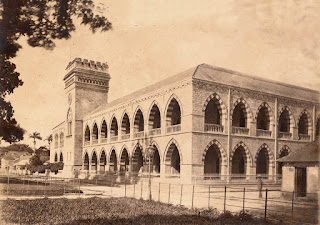
The Police Headquarters at the corner of St. Vincent and Sackville Streets was completed as the organisation continued to grow.
Policewomen were officially introduced to support work involving juveniles and women.
The 1966 Police Service Act marked the transition from a militaristic Police Force toward a service-oriented Police Service.
Francis Eustace Bernard became the first local Commissioner of Police.
The historic Police Headquarters was again affected by fire during the attempted coup.
The Museum of the Trinidad and Tobago Police Service was established at the Old Police Headquarters.
The museum began digitising selected artefacts using photogrammetry for preservation, education and outreach.